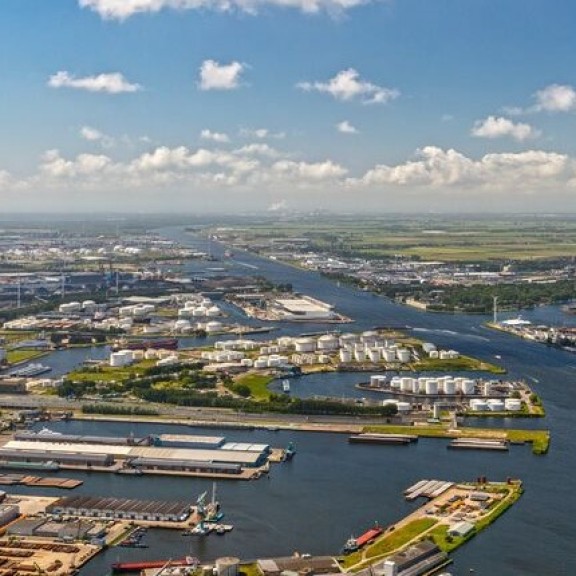
Detailed design for hydrogen network in the North Sea Canal Area completed: “Extensive coordination was needed to arrive at a route that works for everyone”
The detailed design for the hydrogen network being developed by HyNetwork in the North Sea Canal Area has been completed. This covers both a new hydrogen pipeline and an existing natural gas pipeline that will be converted. This marks an important milestone in the technical development of the network. We asked our colleague Thomas Steenbergen how such a network can be integrated into an already busy port area.
Fitting a network into a congested area
Thanks to the detailed design, HyNetwork now knows to the millimetre where the pipelines will be located and how they will be installed. That was quite a challenge in an area already full of underground infrastructure. Thomas Steenbergen, Advisor for Space & Environment at Port of Amsterda,, contributed to how the hydrogen network is integrated: “Aside from the physical space that the hydrogen pipeline occupies, there also needs to be room for a safe positioning. From the network operator’s perspective, ideally there should be a safety zone of about 10 metres around the pipeline. But space in the port area is scarce, so fitting such a safety zone is challenging. In addition, you want the hydrogen pipeline to run close to as many (potential) customers as possible, without compromising future infrastructure plans.”
Because the area is already constrained with cables and pipelines, in some locations the pipeline must be routed deeper underground, explains Thomas: “To arrive at a route that all parties are satisfied with, a lot of consultation was needed between us, network operators, customers and other land users.”
Next steps towards realisation
Based on the detailed design, the contractor can now prepare a final tender. HyNetwork is also using the design to apply for permits and to further develop the environmental impact assessment. Port of Amsterdam is responsible for the permit process for the pipeline location and installation. Thomas comments: “As the port authority, we are mandated by the Municipality of Amsterdam to issue permits for ‘Work in Public Space’ within the port area. One part of this permitting process is approval of the design. Together with some colleagues, I am responsible for ensuring that the interests of the port are taken into account as effectively as possible. That requires good collaboration with the project initiator, HyNetwork Services, to deliver a viable and future-proof route. We are pleased to have reached this point with the detailed design.”
Another piece of the puzzle that still needs to be addressed is the project implementation approach: “We must carefully consider how to maintain accessibility, liveability and safety in the port area during the construction phase.” If all goes according to plan, construction is expected to begin around 2028. Following that, the remaining pipeline sections will be developed so that the North Sea Canal Area can be connected to the national hydrogen network.
Energy security
Hydrogen networks — at local, regional and national scales — are essential for the energy transition. Many companies in the Amsterdam port want to decarbonise but need certainty about hydrogen supply. That certainty requires large-scale and reliable infrastructure. By connecting the North Sea Canal Area to a single national hydrogen network, which is also linked with international markets such as Germany, not only is the supply security of clean energy strengthened, but the role of the Amsterdam port as a hub for hydrogen import, storage and throughput is also underscored.