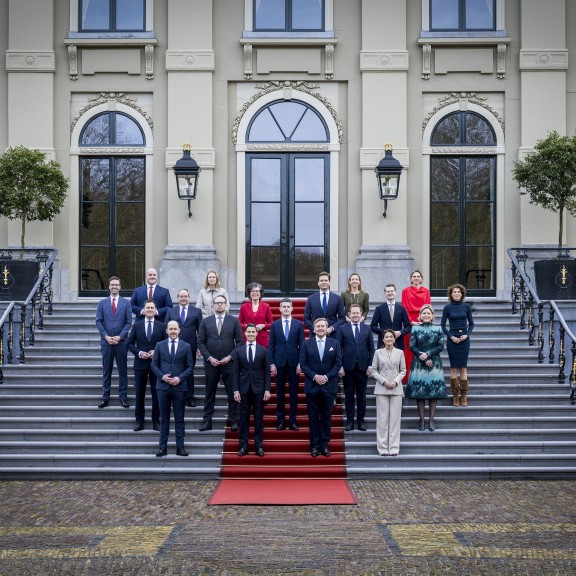
New Cabinet Gets to Work on Entrepreneurship and Future-Proofing
In the coalition agreement, the new cabinet has chosen, among other things, to invest in reducing nitrogen emissions, strengthening the economy and accelerating sustainability. This aligns well with the challenges in our region, and we are therefore positive about this direction.
Opportunities for Sustainability and Cluster Strengthening
We see clear opportunities in the extension of the SDE++ scheme, lower electricity costs for energy-intensive industry, and the further scaling up of offshore wind, hydrogen and carbon capture and storage (CCS). These policy choices made by the cabinet increase investment certainty for companies in the North Sea Canal Area and support the shift towards clean energy.
The national spatial economic strategy for port and industrial areas, as mentioned in the coalition agreement, also provides direction. The implementation of this strategy is crucial to ensure that the North Sea Canal Area connects well with the national cluster approach. The region is home to vital clusters: steel in the IJmond, food in the Zaan region and energy & circular raw materials in the Port of Amsterdam. Together they contribute to broad prosperity, supply security and strategic autonomy.
Conditions That Require Attention
At the same time, execution remains challenging. Reducing nitrogen emissions continues to be decisive for permitting and the progress of housing and economic (sustainable) development. It is also important to continue nature restoration and organise it legally so that projects can be delivered predictably and without unnecessary delays.
In addition, the accessibility of our region needs attention. The available budget for infrastructure is not in proportion to the scale of the task, such as the construction of a new pumping station and the renovation of the lock complex. Reliable connections via road, water, rail, pipeline and cable are essential for our economy, safety and sustainability ambitions.
Finally, more clarity is needed on the financing and planning for offshore wind, hydrogen and associated infrastructure – including for the Energiehaven IJmond. For companies, government certainty and predictability are necessary to make investments. Decisions and choices are needed so that projects can be realised at pace and the future-proofing of the Dutch energy system can be strengthened, in which the Port of Amsterdam plays a very important role.
We look forward to working with the new cabinet, regional partners and companies to focus on energy security, sustainability and economic development for a strong, sustainable and future-proof port, Green Port Amsterdam.
In the coalition agreement, the new cabinet has chosen, among other things, to invest in reducing nitrogen emissions, strengthening the economy and accelerating sustainability. This aligns well with the challenges in our region, and we are therefore positive about this direction.
Opportunities for Sustainability and Cluster Strengthening
We see clear opportunities in the extension of the SDE++ scheme, lower electricity costs for energy-intensive industry, and the further scaling up of offshore wind, hydrogen and carbon capture and storage (CCS). These policy choices made by the cabinet increase investment certainty for companies in the North Sea Canal Area and support the shift towards clean energy.
The national spatial economic strategy for port and industrial areas, as mentioned in the coalition agreement, also provides direction. The implementation of this strategy is crucial to ensure that the North Sea Canal Area connects well with the national cluster approach. The region is home to vital clusters: steel in the IJmond, food in the Zaan region and energy & circular raw materials in the Port of Amsterdam. Together they contribute to broad prosperity, supply security and strategic autonomy.
Conditions That Require Attention
At the same time, execution remains challenging. Reducing nitrogen emissions continues to be decisive for permitting and the progress of housing and economic (sustainable) development. It is also important to continue nature restoration and organise it legally so that projects can be delivered predictably and without unnecessary delays.
In addition, the accessibility of our region needs attention. The available budget for infrastructure is not in proportion to the scale of the task, such as the construction of a new pumping station and the renovation of the lock complex. Reliable connections via road, water, rail, pipeline and cable are essential for our economy, safety and sustainability ambitions.
Finally, more clarity is needed on the financing and planning for offshore wind, hydrogen and associated infrastructure – including for the Energiehaven IJmond. For companies, government certainty and predictability are necessary to make investments. Decisions and choices are needed so that projects can be realised at pace and the future-proofing of the Dutch energy system can be strengthened, in which the Port of Amsterdam plays a very important role.
We look forward to working with the new cabinet, regional partners and companies to focus on energy security, sustainability and economic development for a strong, sustainable and future-proof port, Green Port Amsterdam.