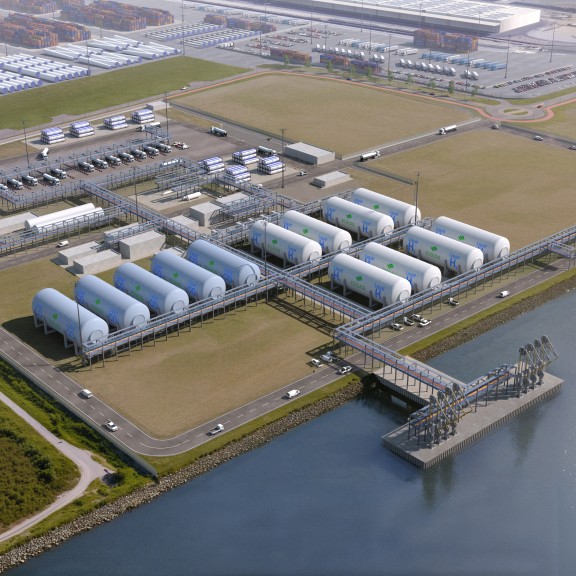
EcoLog continues development of liquid hydrogen import terminal
EcoLog has taken an important step in the development of a liquid hydrogen import terminal in the Port of Amsterdam. This week, the company signed an agreement in Tokyo with a group of technology partners that will supply equipment for both the future import terminal and the vessels that will transport the hydrogen. The signing took place in the presence of the Ambassador of the Kingdom of the Netherlands to Japan, H.E. Gilles Beschoor Plug.
The consortium partners – Ebara Corporation, Fukui Seisakusho, Kobe Steel and TB Global Technologies – will provide equipment and technical solutions for EcoLog’s liquid hydrogen vessels as well as for the planned import terminal in Amsterdam.
World’s first liquid hydrogen import terminal
In close cooperation with Port of Amsterdam, EcoLog is developing a terminal for the import of liquid hydrogen (LH₂) and the export of liquid CO₂ (LCO₂) in the Afrikahaven. It will be the first terminal of this scale worldwide. The terminal is expected to become operational around 2030 and, in its initial phase, will have an annual throughput capacity of 200,000 tonnes of liquid hydrogen and 1.8 million tonnes of liquid CO₂.
Liquid hydrogen can be transported efficiently and safely via pipelines, inland shipping, rail and road. Through the Amsterdam terminal, hydrogen can be supplied to customers in the region, elsewhere in the Netherlands and in Germany, for use in sectors such as industry, mobility, shipping and aviation.
Specialised vessels require specialised equipment
Alongside the development of the terminal, EcoLog is also working on specialised vessels for the transport of liquid hydrogen. Both maritime transport and terminal operations require highly specialised equipment. EcoLog has therefore entered into a framework agreement with its partners to jointly develop and integrate this equipment into the vessels and the terminal. This includes, among other things:
- pumps for loading and unloading liquid hydrogen;
- safety relief valves to reduce tank pressure in emergency situations;
- heat exchangers to convert liquid hydrogen into gaseous form, enabling onward transport via pipelines after arrival;
- so-called marine loading arms for the safe loading and unloading of vessels.
By working together on an integrated solution for vessels and terminal, the realisation of the import corridor moves a step closer. In the coming period, EcoLog will continue to work on the detailed design of the terminal and the permitting process. Based on the current planning, the company is working towards realisation of the terminal in 2030.
Import of green hydrogen essential for industrial decarbonisation
The import of green hydrogen is essential for the development of the European hydrogen economy and for the decarbonisation of industry. In the Netherlands, there is insufficient space and capacity to produce all the green hydrogen required domestically. Imports from other regions are therefore necessary.
Earlier this year, an agreement was signed with partners from Oman, Germany and the Netherlands to enable the import of liquid hydrogen. The development of the terminal in the Port of Amsterdam aligns with this international cooperation and with the broader ambition to supply North-West Europe with green hydrogen.